
 Vietnamese
CAD Software Solutions
PTC’s computer-aided design (CAD) solutions have been the industry standard for product design and development software for parametric modeling, simulation and analysis, and product documentation for more than 30 years. Everyone’s product development challenges are unique—so you need choices, from robust on-prem solutions to innovative pure SaaS CAD solutions.
What is CAD?
|
Computer-aided design (CAD) is a way to digitally create 2D drawings and 3D models of real-world products before they’re ever manufactured. With 3D CAD, you can share, review, simulate, and modify designs easily, opening doors to innovative and differentiated products that get to market fast.
In 1985, Dr. Samuel Geisberg formed Parametric Technology Corporation (PTC) and defined a radically new approach for CAD software. This innovation produced the first parametric and feature-based solid modeling CAD software in the market, which today is known as Creo, the industry standard for product design and development software.
More than 30 years later, the product development industry is beginning to adopt the next wave of technology-driven innovation, as so many other industries already have |
Benefits of CAD
Reduce time to market
Increase engineering productivity by quickly modifying and updating designs, speeding up the design process, and reducing the risk of errors.
Enhance documentation and communication
Generate documentation directly in CAD software to accurately capture design data and provide detailed visual representation ensuring alignment among team members.
Increase product development efficiency
Rapidly evaluate design options for optimization. Identify and eliminate design flaws early in the development process to reduce the cost and time from rework.
Streamlined manufacturing
Accelerate high-quality innovation
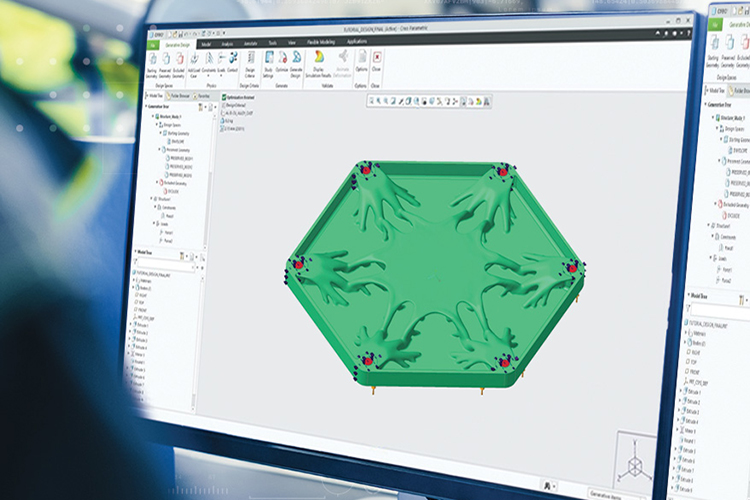
Artificial intelligence in CAD
Artificial intelligence (AI) is revolutionizing the CAD industry by enhancing design efficiency, accuracy, and innovation. AI-driven tools leverage machine learning algorithms to automate repetitive tasks, generate optimized designs, and predict potential issues before they arise. This not only accelerates the design process but also improves the quality and functionality of the final product. AI-powered generative design and simulations enable engineers to test multiple scenarios quickly, enabling greater design exploration, reducing the need for physical prototypes, and minimizing costs.